
Photo Prayer: Ashley Makar
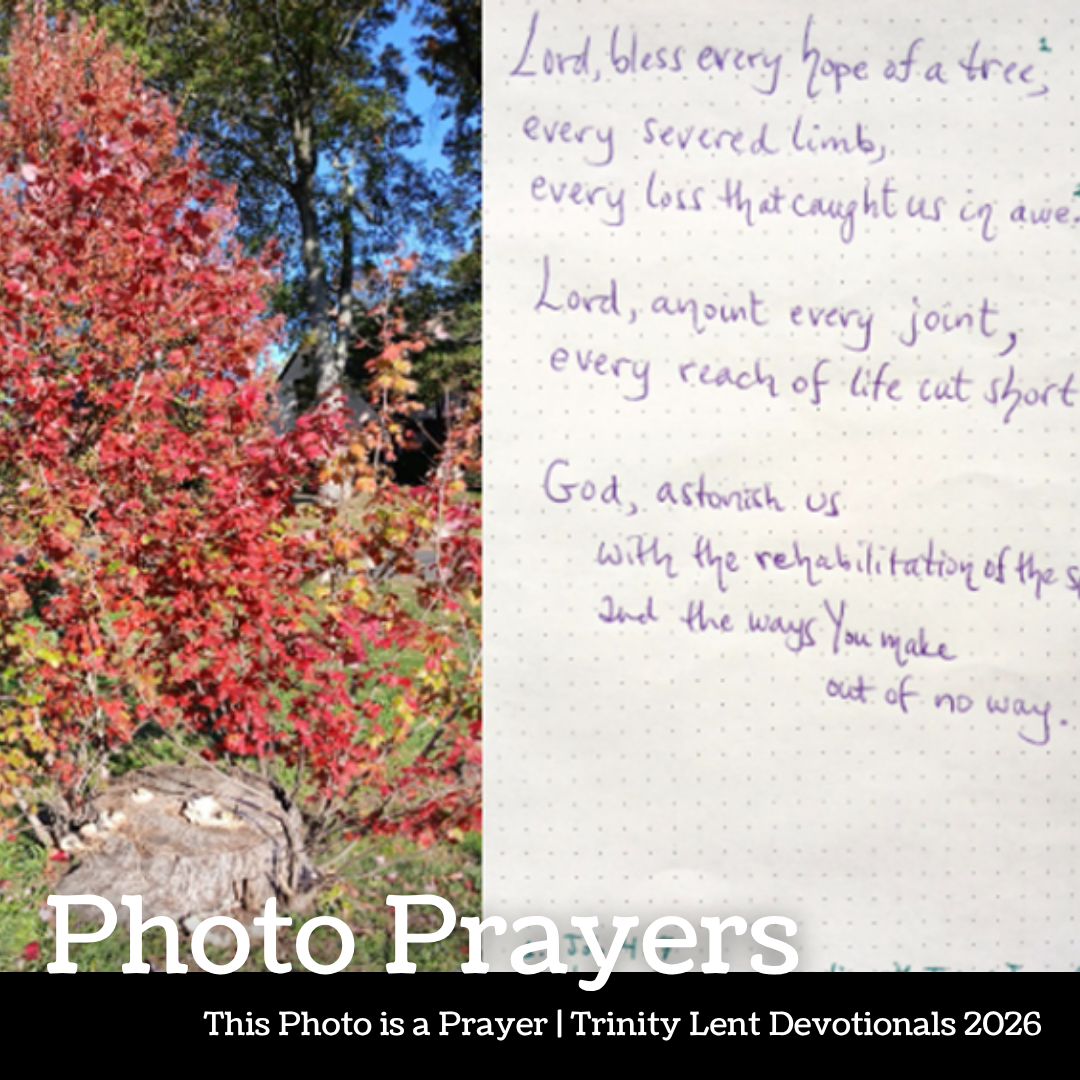
I discovered this stump with shoots branching into new trees on a walk in Spring Glen last fall, the leaves bright as flames, so alive while they were dying.
For there is hope [of] a tree,
if it is cut down, that it will sprout again
and that its shoots will not cease.
Though its root grows old in the earth
and its stump dies in the ground,
yet at the scent of water it will bud
and put forth branches like a young plant.
–Job 14:7-9
This Lent, I’m reflecting on Job’s hope of a tree in light of my work alongside Sudanese asylum seekers and refugees.
My friend Jurkuch, who was a Trinity parishioner before he moved to Vermont in 2015, has seen his hometown Bor shattered by two wars since he left South Sudan with his siblings and thousands of other children, who are now mothers and fathers themselves. He talks about “all that caught us in awe–loss after loss after loss.” In his forthcoming book, which tells the story of his life, his people, and their connection to their ancestors, Jurkuch writes, “We are the seeds of a New Sudan.” It’s a prophetic vision he keeps alive by faith. He seems to know, as Job knows, that loss is not the whole story, and certainly not the end of the story.
Once I asked Jurkuch, “How do you keep your hope?”
He laughed. “Sudanese people sing too much.”
At around the same time, the South Sudanese Anglican Mothers’ Union of the Diocese of Bor were leading singing vigils and “Peach Torch” marches, as part of their “101 Days of Prayer for Peace” initiative. “When we process with the lantern, we are telling the soldiers that this land belongs to God’s fire, not their fire,” one Mother told The Sudan Tribune. “We sing until our voices are like a wall." During the vigils, they would keep watch all night, surrounded by lanterns and candles, praying and singing hymns of lament and hope. In one of the hymns they would sing, “Let us shake the earth with prayer…Our leaders have failed us…But the Word of God does not fail, It remains as a shade over the land. Come, brothers and sisters, let us fall on our knees, Until the earth itself trembles with our voices. For only God can bring peace to this dust.”
*
Mohammed, a community leader from Darfur who now lives in New Haven, has seen two genocides targeting his tribe in his lifetime. He was among 2 million indigenous people who fled the 2003-2005 massacres to obliterate the Masalit, Zaghawa, and Fur communities. After the current war broke out in 2023, Ali’s dad and siblings, along with 400,000 other survivors, made the dangerous 20-mile walk to a refugee camp in Chad. Children were pushing their injured elders in wheelbarrows; many parents had lost limbs. Over 100 were driven into the Kaja River and shot while trying not to drown.
“These people lost everything,” Mohammed tells me. And yet he has the faith to envision a day when his homeland will be restored. This is how his friend Ibrahim remembers Darfur after the rainy season: “Everything is growing and green, and the mangoes fall like leaves.” While they long for the day they can go home, they are participating in diaspora mutual aid networks, pooling their resources to send vital supplies to Sudanese refugees in Chad.
*
I didn’t understand the hope of a tree verse from Job until I started noticing shoots growing from trees that have been cut down–an astonishment I’ve come to call stumpwonder. A stump can put forth branches like a young plant because there are dormant buds just under the bark. When a tree experiences distress–like losing a limb or the trunk being cut down, those buds wake up. The stump’s roots fuel them with water and nutrients. The buds become shoots so strong they crack the bark.
*
My friend Amal’s mom lives with a disability and cannot make the treacherous journey that thousands of refugees from North Sudan have made–by foot, by bus, by riverboat–to Egypt. Amal is praying to find a way to bring her mom to safety in the U.S. With Sudan on the travel ban list, she has scant chance. When I tell her I’m sorry, Amal tells me, “Even when you are broken inside, you have to keep your hope. Even if it is small, like a match.”
The Sudanese people are my greatest teachers in spiritual hope–a kind of unlikely light, a little flame, that can come from the tenderness of a broken spirit
*
Early in his lament, Job tells God how broken his hope is:
"My days are swifter than a weaver's shuttle and come to their end without hope.” (Job7:6)
After losing his children, his possessions, and his health, Job sits on a heap of ashes.
After God speaks from the whirlwind, Job repent[s] in dust and ashes. (42:6)
Rather than try to interpret Job’s repentance, I’ll turn back toward the ashes that bookend Job’s story. It’s after a long silence on the ash heap that he speaks about the hope of a tree and laments that humans don’t get to regenerate like a stump.
It’s as if the shards of Job’s broken hope, and the ashes of all that he’s lost, are propelling his voice–to call out to God, to cry out to God, to ask God searing questions. I believe that prayer–especially lament, is our greatest defense against despair. And the ash heaps of our grief can be the makings of our healing.
*
The ashes we bear in the shape of the cross when we enter Lent are a mark of embering. Yes, they help us remember we are dust, and to dust we will return. And they can also kindle in us the living hope that glows like the torches and lanterns of the South Sudanese vigils, the women singing only God can bring peace to this dust.
Their fire reminds me of Jan Richardson’s stunning poem “Blessing the Dust”:
…did you know
what the Holy One
can do with dust?
…
we ask for the blessing
that lives within
the ancient ashes,
that makes its home
inside the soil of
this sacred earth.
So let us be marked…
for claiming
what God can do
within the dust,
within the dirt,
within the stuff
of which the world
is made
and the stars that blaze
in our bones
and the galaxies that spiral
inside the smudge
we bear.
— Jan Richardson from Circle of Grace: A Book of Blessings
*
Perhaps the ashes of grief are the bookends of Lent: Ash Wednesday, Jesus weeping at Gethsemane, Good Friday, the women at the empty tomb, in the luminous blue before dawn.
This Holy Week, I lament the ashes of Sudan. I ask for the blessing that lives within the ancient ashes, that makes its home inside the soil that nourishes the roots that hold the hope of a tree. I remember Ezekiel prophesying to the bones and the breath. I imagine what God can do with ashes.
*
hope like a match
a smudge of ash
a crack in the bark
a bud becoming a tree,
a forest of we, a people
acquainted with miracle and disaster[1]
healing and gladdening together.
[1] Phrase from The New Union Prayerbook for the Days of Awe.