
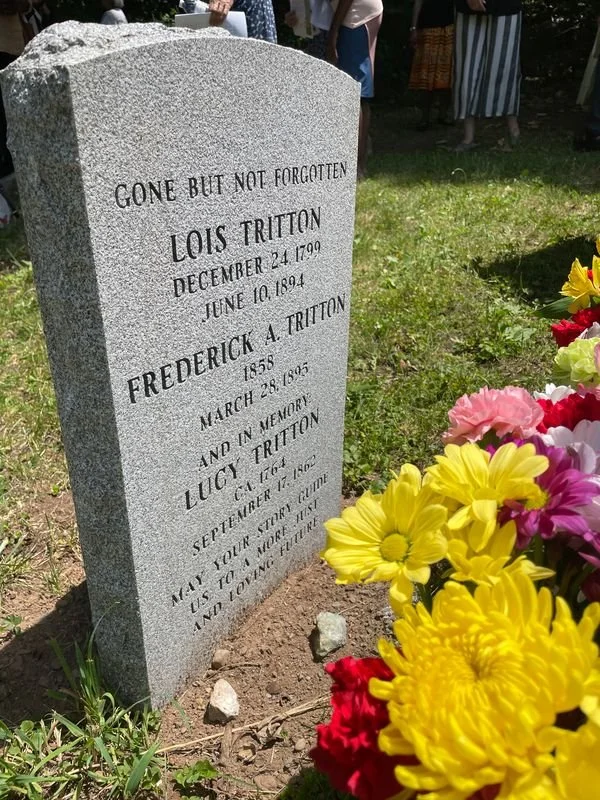
Lucy and Lois Tritton
Lucy and Lois Tritton were the last two enslaved people to be sold at auction on the New Haven Green. We are committed to remembering and telling Lucy and Lois’ story, acknowledging our complicity in the sin of racism as we live into our baptismal promise: “to strive for justice and peace among all people, and respect the dignity of every human being” (The Book of Common Prayer, p. 305).
In June 2026 we held a joint prayer service with St. Luke’s Episcopal Church in New Haven to dedicate a new memorial stone acknowledging Lucy, Lois, and their Descendants. This memorial was made possible by Jill Marie Snyder, St. Luke’s Episcopal Church in New Haven, Friends of the Green, and many community partners. We offered many prayers, including these words:
God of grace and glory, we remember before you this day our sisters Lucy and Lois, and their descendants. We thank you for their example of faith in the face of great injustice. We pray for the liberation of all people, that your kingdom might be known not only in heaven but here on earth. Give us faith to embody your kingdom of peace and justice here on earth, until, by your call, we are reunited with those who have gone before; through Jesus Christ our Lord. Amen.
The Story of Lucy & Lois
Written by Jill Marie Snyder, Community Historian
Lucy and her parents were stolen from Africa in the mid-1700s. They were brought to the island of St. Thomas in the Caribbean. This suggests they may have come from modern-day Ghana, where the Danish king had a slave fort for holding captured Africans before sending them across the Atlantic to St. Thomas, then a Danish colony. St. Thomas served as a slave depot where African men, women, and children were sold to buyers throughout the Americas. Lucy and Lucy’s father were sold to an Englishman whom she called General Tritton. He took them to London. We do not know the fate of Lucy’s mother.
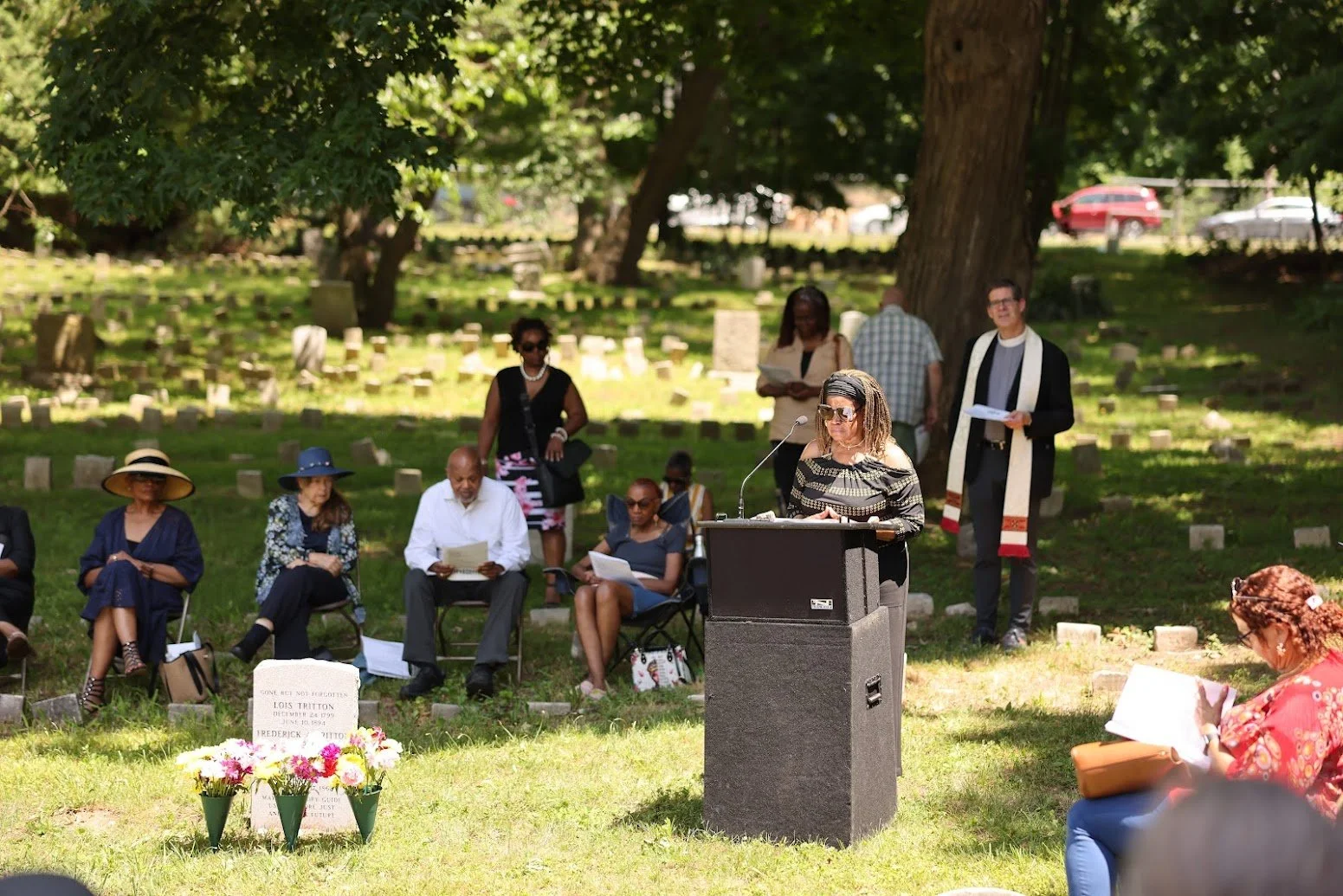
Dedication and Commemoration for Lucy and Lois Tritton and their descendants. Westville Cemetery, New Haven, June 14, 2026.
After living in London for a period, the Tritton family moved to Nova Scotia. The Tritton family also had a second home in New Haven and attended Trinity Church when in town. During one of the family’s stays in New Haven, it was revealed that ‘General’ Tritton was not a general. He was a merchant ship captain. In 1790, he drowned at sea when his ship sank during a storm. One of the highest valued “possessions” listed in his estate inventory was ‘Negro girl Lucy.”
Lucy's daughter Lois was born in 1799. In 1806, her baptism was recorded in the Cornwallis, Nova Scotia Township Book. She was listed as “the enslaved ‘mulatto’ child” of Mrs. Tritton. At some point after Captain Tritton’s death, his widow Sara Tritton needed money. Mrs. Tritton had used Lucy and Lois as collateral for a loan from a man named Jacocks who sold the loan to a man named John Nicoll. When Mrs. Tritton couldn’t repay the loan, New Haven’s sheriff arranged an auction to sell Lucy and Lois to generate funds for repayment. It’s noted in a book titled Slave in Canada that Lois was taken to Connecticut “to be sold in 1824.” Before being auctioned on the Green, Lucy and Lois were marched through New Haven’s downtown streets, led by a drummer, shouting, “slaves for sale.”
Documents at the New Haven Museum indicate they were purchased for $10 each by Mr. Anthony Sanford who issued freedom certificates that are in the New Haven Museum. However, the auction on the Green was carried out despite a 1774 Connecticut law outlawing the importation of slaves into the state. In addition, the Connecticut Gradual Abolition Act of 1784, set forth female slaves would become free on attaining the age of 21. Lois was born in 1799; thus, Lois should have been freed under both laws.
Lois, in her many interviews, never mentioned receiving a freedom certificate. In her most extensive interview, she states that she was owned by Mr. Sanford and had to work extra hours for several years to earn $600 to buy her freedom. It’s possible that Mr. Sanford considered Lois indentured rather than enslaved. Regardless of the method, Lois was still bound to Sanford for several years. It’s likely that Mr. Sanford paid off the loan that Mrs. Tritton owed, and, unknowingly, Lois repaid Mr. Sanford.
After being released from bondage, Lois continued to work with her mother Lucy as a laundress, a common occupation for African American women. It was profitable but strenuous and potentially dangerous work, requiring lifting heavy laundry loads, using caustic chemicals, and toting buckets of water. In 1880, Lois was recorded in a genealogical site as being married to Asa Jeffrey. His 1885 death was recorded in Wisconsin, so he and Lois were no longer together at that time. Lois had a son, Henry, who was a barber. Through him, we believe Lois has living descendants.
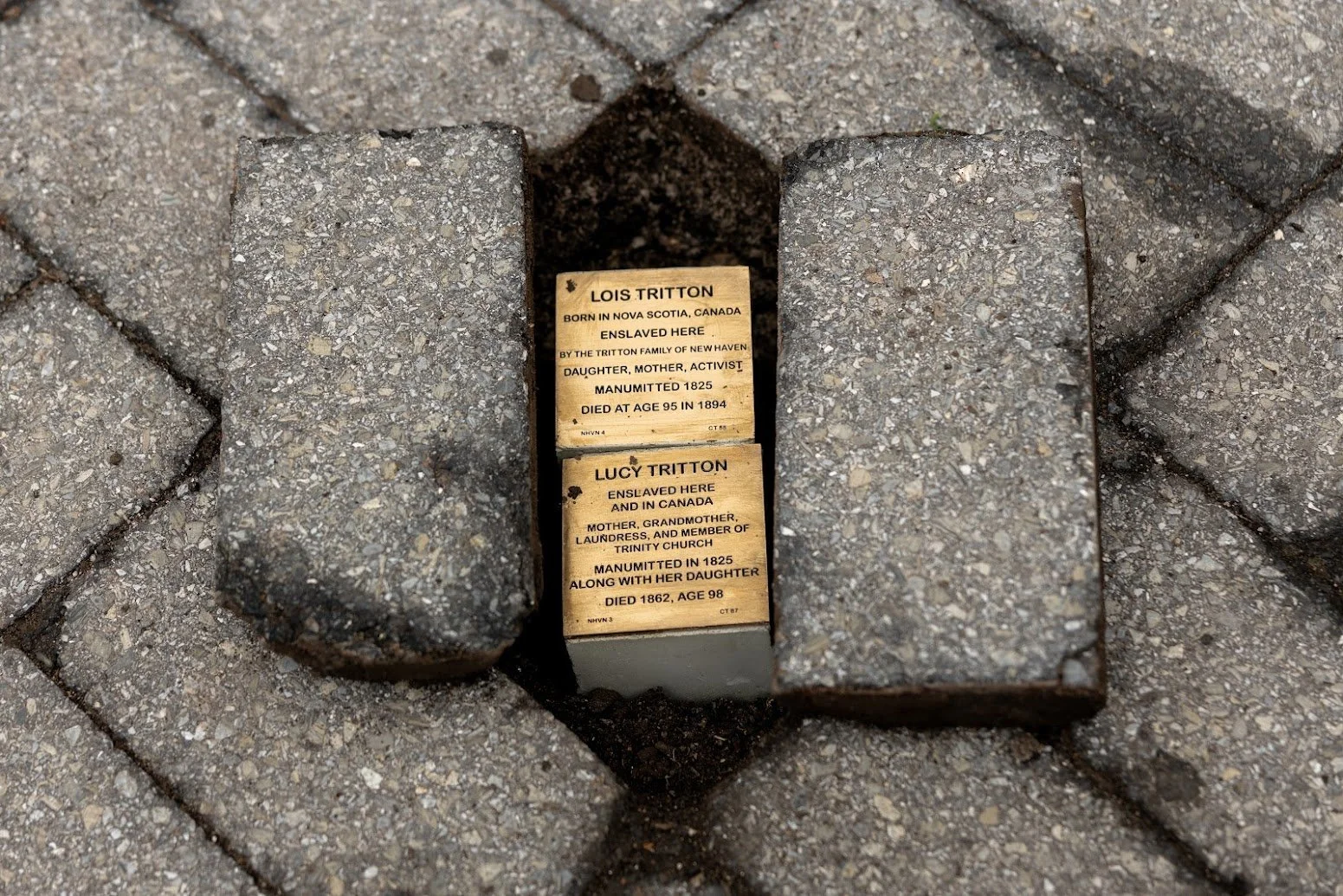
We began to learn about Lucy and Lois through a collaboration with The Witness Stones project in 2022. These stones are installed in front of our church, as a memorial to Lucy and Lois.