
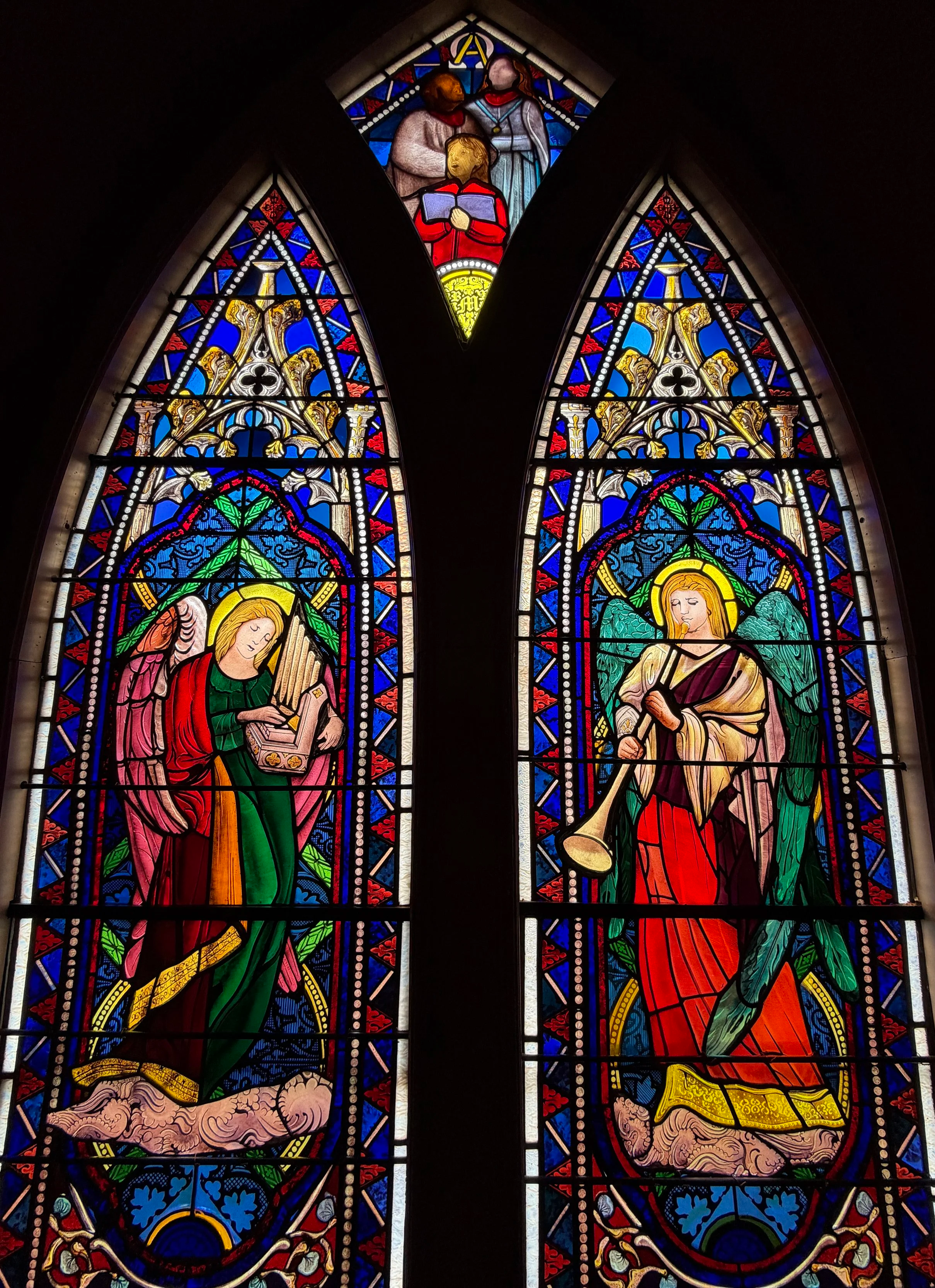
Trinity’s Newest Stained Glass Window
Dedicated on November 22, 2026, with gratitude for a generous donation from Wayne A. Schwartz and the skillfull work of Michael Mezalick and Mezalick Design Studio.
Address by Michael Mezalick
Given November 22, 2026
Good morning,
I’m Michael Mezalick from Mezalick Design Studio, located in Philadelphia, PA. My wife, Nidia, and I had the distinct pleasure—and honestly, the great honor—of designing and creating this new stained glass window for Trinity on the Green. Before I say anything about the window itself, I want to thank the members of the church, Pastor Luk, and the stained glass committee who guided us through this process. And, in particular, I want to thank Mr. Wayne Schwartz. Wayne not only generously made this window possible, but he became part of the process and a friend. He listened to ideas, asked questions, offered suggestions, and trusted us to take those ideas and turn them into glass.
The direction we were given was very clear: Psalm 150—the Psalm of Praise.
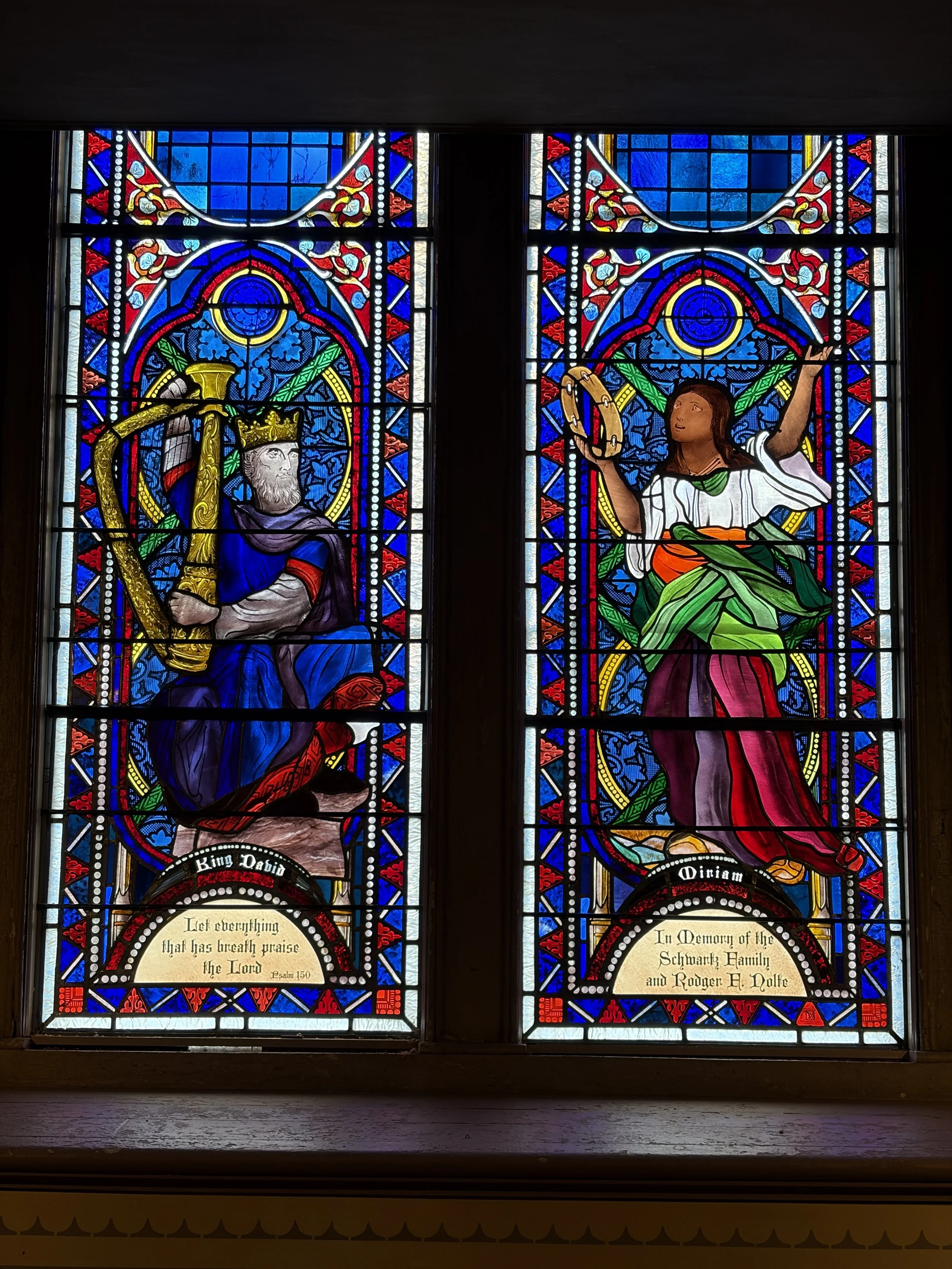
The original concept was to have four angels, all in a medieval style, with cobalt blue and ruby red as the dominant colors. But as we worked on the design, we started thinking about what praise really means. And we decided that perhaps the window shouldn’t only show angels praising God. It should show people praising God, too. So, we took a little liberty with the original concept. We replaced two of the angels with two very important Biblical figures. The first is King David, holding his harp. The second is Miriam, the older sister of Moses, holding a timbrel—an ancient percussion instrument very much like a tambourine. From the Book of Exodus: “After the Israelites crossed the Red Sea, Miriam took her timbrel, gathered the women, and led them in singing, dancing, and celebrating their victory.” That became an important part of our story.
At the bottom of the window, we begin with the dedication to the Schwartz family. From there, we move upward to David and Miriam—human beings using music to praise God. Above them are the angels, with their instruments. And finally, at the very top, we have three members of the choir, raising their voices in song. We included the small medal, which represents their accomplishments and progression within the Trinity Choir Program. So, the window moves upward—from memory, to human praise, to heavenly praise.
A Little History
Stained glass has been around for roughly 1,300 years. And, as I like to say, not much has changed—except for electricity and coffee breaks. In the Middle Ages, stained glass served an important purpose. It told biblical stories, especially to people who could not read. It transformed ordinary sunlight into something beautiful and spiritual, and it helped create a separation between the sacred space inside and the world outside. We wanted to respect that tradition. That’s why we deliberately stayed with a medieval feeling—rather than creating something contemporary. But we also wanted the window to belong to this church, the people, and this particular story, Psalm 150.
The Details You May Not See
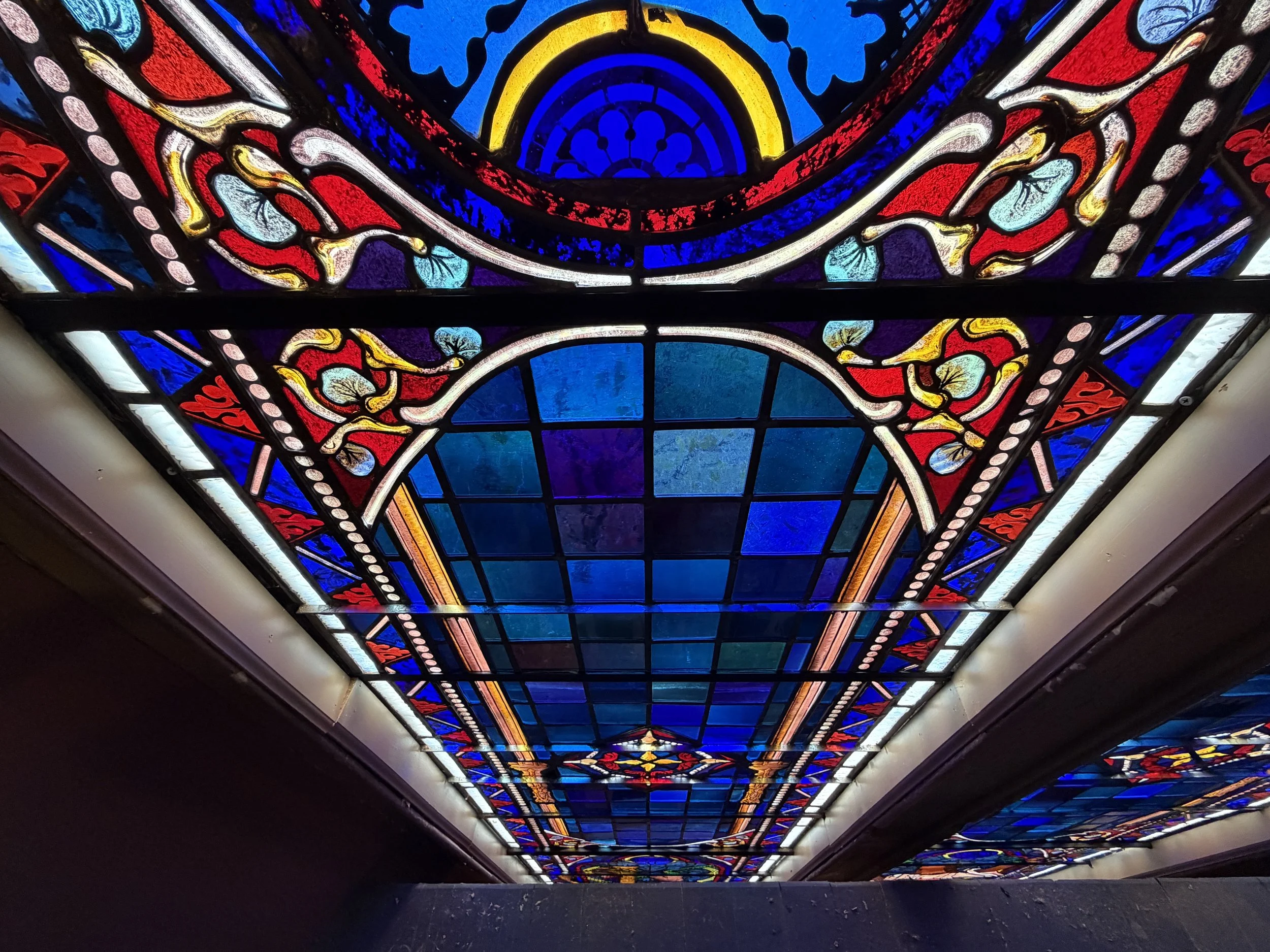
One of the things I love about stained glass is that there are always things hiding in plain sight. For example, there are almost 400 pieces of blue glass just in the border. There are approximately 210 red triangles, each painted by hand, and roughly 1,200 circles. There are also some very personal details.
The Side Gallery: This area, not easily visible from the interior of the church was to be a simple pattern of blue. We used about 150 rectangular glass pieces, from 7 different glass manufactures, 34 different shades of blue, with their age ranging from present day to about 200 years old. In the center of the panel, most visible from the outside, is a small design made up of about 110 pieces of glass. I decided to include that for a personal reason. My uncle Joseph—my father’s brother—was killed on the beaches of Normandy on the second day of the invasion. He is buried at the Normandy American Cemetery in France. Not far form the cemetery is the medieval church of Notre-Dame de Sainte-Marie-du-Mont, which dates back to the 12th century. I found a small design element from that church and incorporated it into this window in honor of him. Most people will never know it’s there. But I will. And that’s one of the wonderful things about making something by hand. There can be a personal story hidden inside it, even if no one else ever sees it.
Other Personal Touches: Walden Moore, the former Director of Music for 4 decades, his monogram is incorporated into the design, at the bottom tip of the kite, the uppermost panel. The twelve circles above his monogram represent the twelve keys in an octave. Nidia’s hands were used for the angel holding the trumpet. And, perhaps a little strangely, my own right hand became the hand of King David holding his harp. In a very real way, this window carries a piece of many people with it.
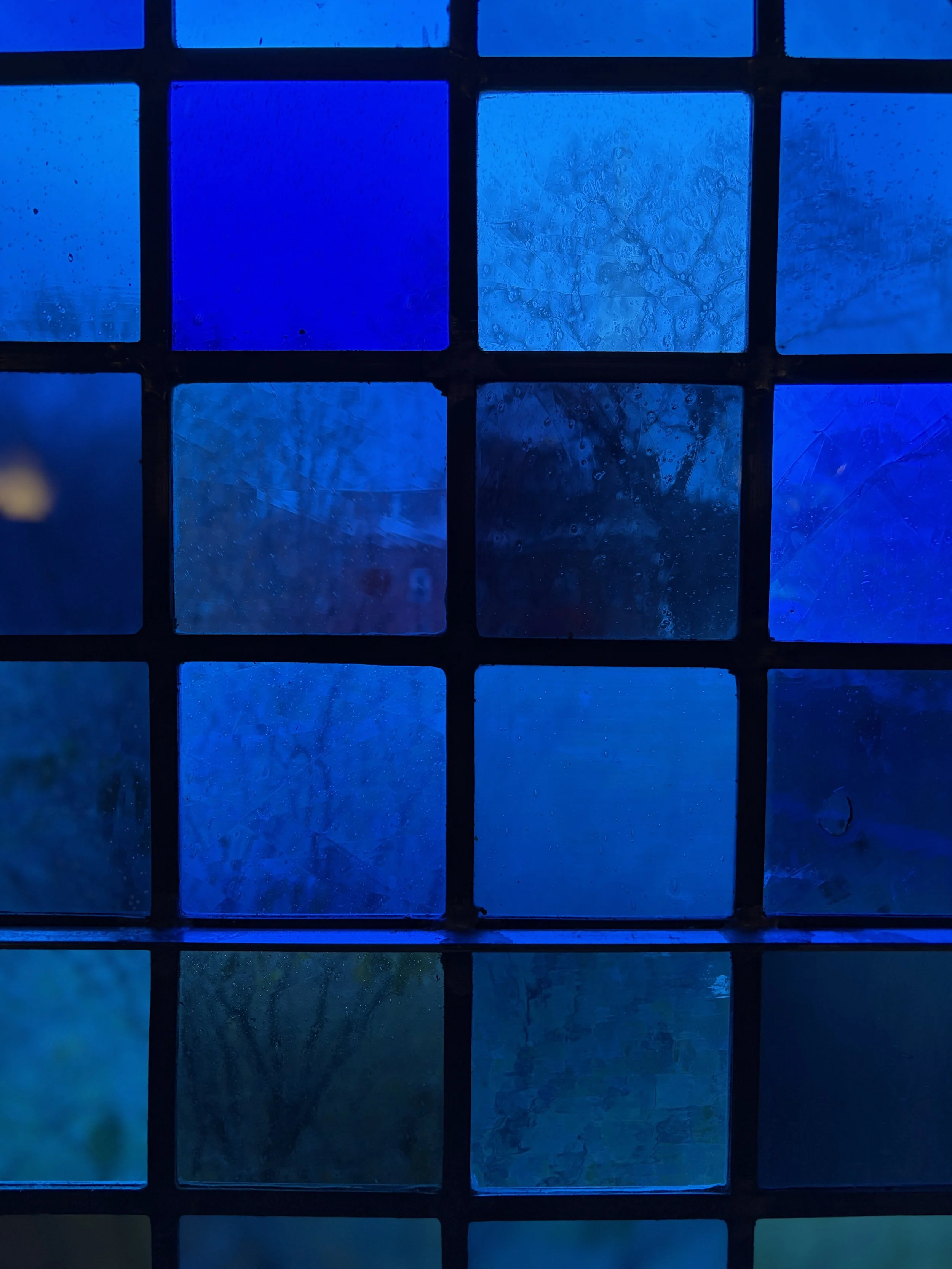
During the fabrication of the window, it was suggested that it would be wonderful to incorporate some of the original stained glass into the new design. I loved the idea. We decided to use some of that original glass as the background behind the figures. But the original glass was very light and didn’t work with the design (similar to the stairwell windows that are also designed in that same style). So we tried something slightly different—we added blue glass to the exterior side of the light colored glass. It worked beautifully. When you look at the figures in this window, the blue background you see (and the green and yellow) is actually part of the original window.
But that original glass has another story. While we needed panels to obtain some of the original glass that would be incorporated into the new window, I fell from the window sill as we were taking down the scaffolding. I landed on my back against the edge of a pew and broke a vertebra bone into three pieces. I spent three days, on my back, in the ER at Yale New Haven Hospital before surgery, followed by several days of recovery. During that difficult time, something happened that I will never forget. Members of this church came to visit me, including Wayne Schwartz, the donor of this window. No one asked, “ When will the work be finished?” No one suggested finding another studio to finish the project. You cared about me. That kindness, your prayers, and your support meant more to me than I can ever express. It strengthened my faith and reminded me of the power of prayer.
When you look at that background glass, I hope you will see more than a piece of the original window. I hope you see a piece of its history—and a reminder of the love, faith, and kindness that are part of the history of this church. I thank God every day that I was given the opportunity to stand here and share that story with you.
Looking Upward
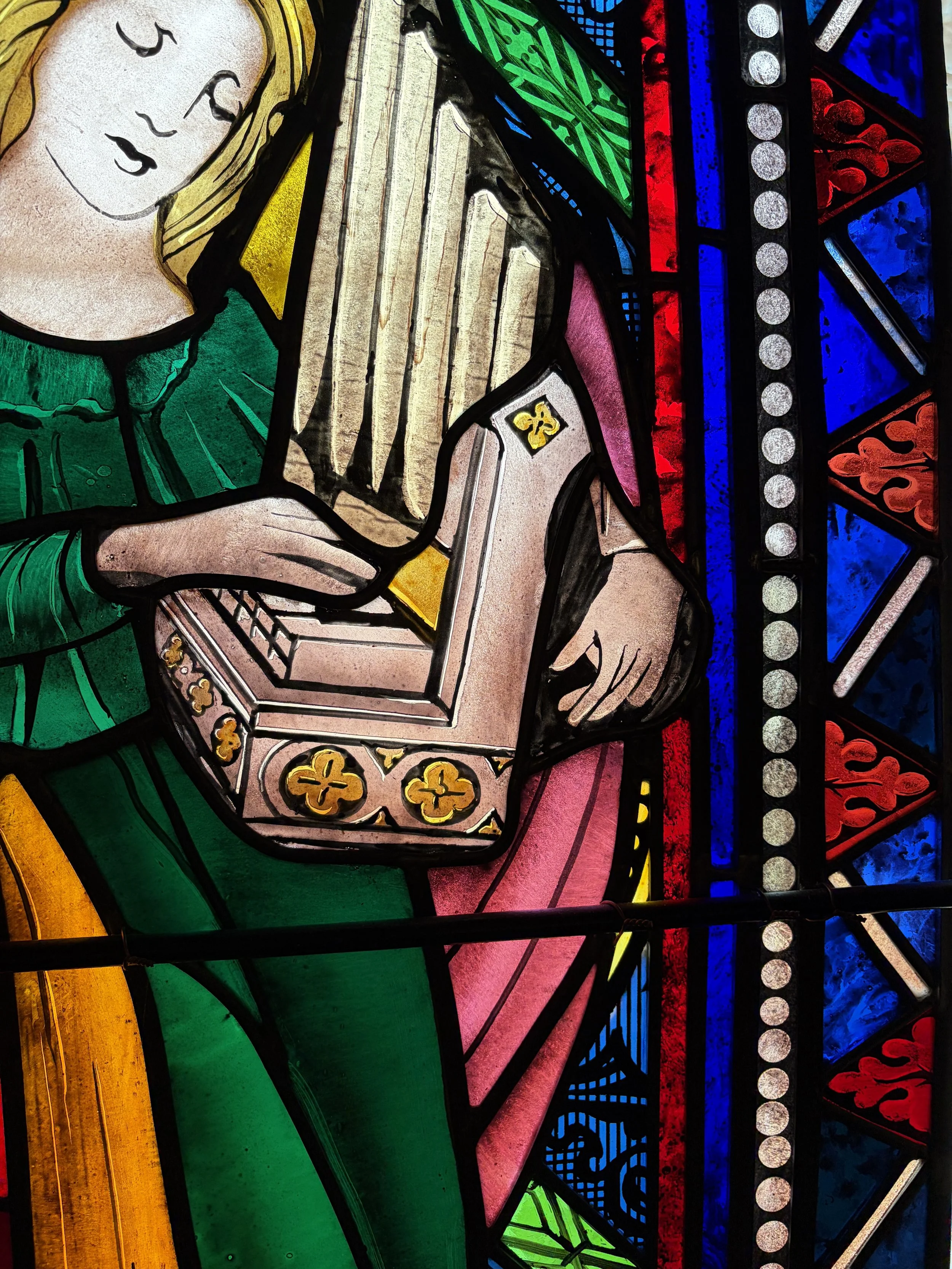
As you look up, toward the top, the story becomes more and more about sound. King David and Miriam rejoicing in song. The angels are playing instruments that would have been familiar in the medieval world—one with an early form of an organ (a Portative organ, organetto), and the other with a medieval fanfare trumpet. And then we arrive at the choristers. Three young people, singing. Which brings us back to where we started—Psalm 150. It tells us to praise God with the trumpet, with the harp, with the timbrel, with strings and pipes, and with dancing. And then it ends with perhaps the simplest and most beautiful instruction of all: “Let everything that has breath praise the LORD.” That is really what this window is about. Not just angels. Not just David or Miriam. Not just the choristers. But all of us. Anything that has breath has a voice, and that voice can be used in praise.
On a side note, coincidentally; St. Cecilia of Rome, widely known as the patron saint of music, her feast day is today, November 22. Thank you.
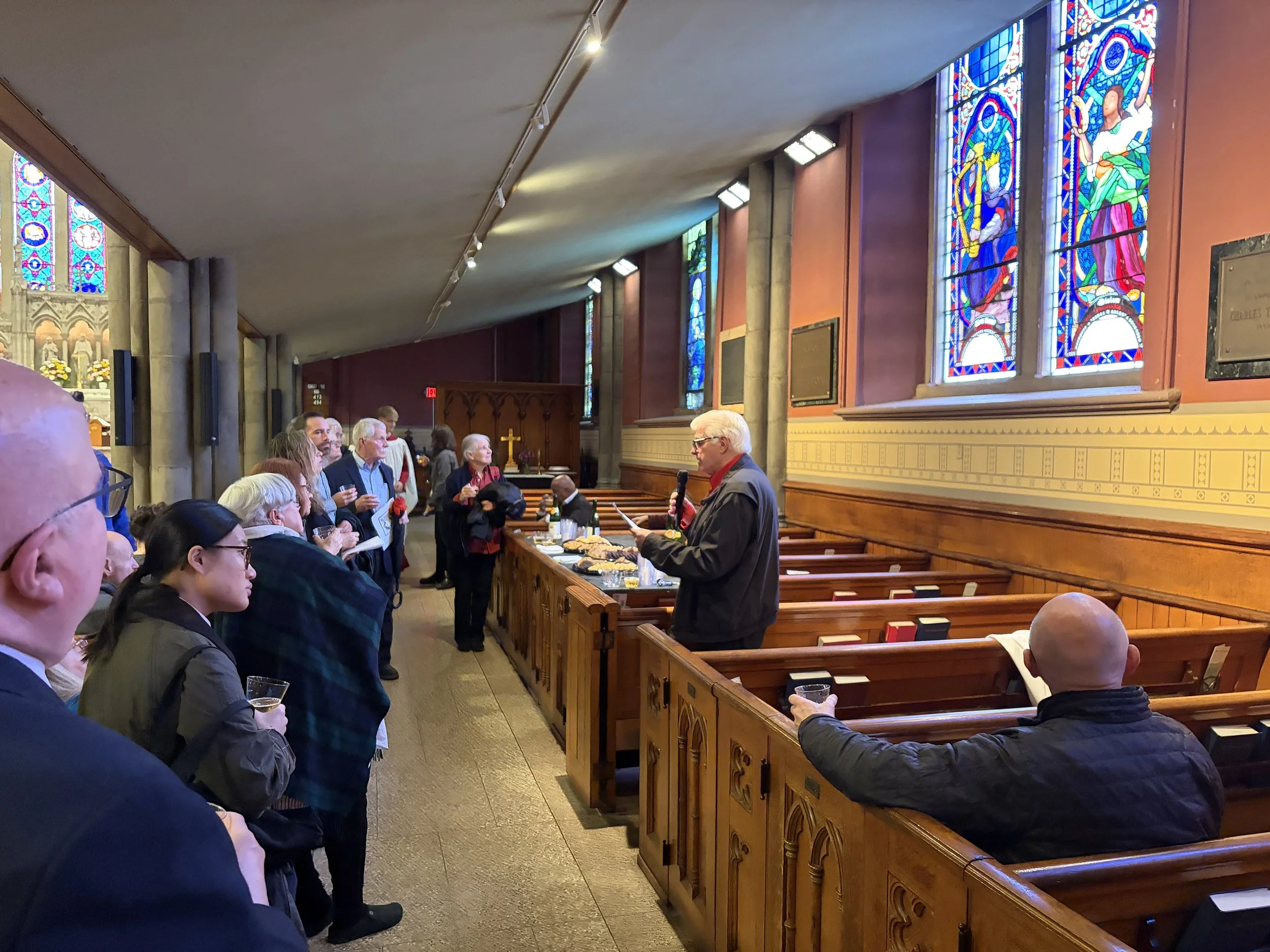
Michael Mezalick giving an address about the new window on Sunday, November 22, 2026.